Four Minutes a Day Added 4 Chair Stands in 12 Weeks — What a 97-Person Penn State Trial Found
Four minutes. That's the whole workout: push-ups, chair stands, band rows, and step-ups, 30 seconds each, once a day, at home. In a 2026 randomized trial from Penn State, 97 inactive adults aged 65 and older — average age 74, every one of them already having trouble walking a quarter mile — did that routine for 12 weeks. Compared with a group that did nothing, they managed 4.2 more chair stands in 30 seconds, balanced 3.6 seconds longer on one leg, and rose from a chair 2.3 seconds faster. The dose was tiny on purpose: the researchers wanted to find the shortest routine that still works, because the people who need strength training most are the ones least likely to sign up for an hour at the gym. The honest catch is just as small as the dose: 97 people, 12 weeks, and function tests only — no data on falls, bones, or heart health.
Why the question matters
Strength training is one of the clearest recommendations in aging research — it protects mobility, independence, and the ability to do everyday things like getting out of a chair or climbing stairs. Yet fewer than one in five older adults do the recommended two days a week of muscle-strengthening activity, and even free programs like SilverSneakers draw fewer than 30% of eligible older adults. The usual explanation is that the standard prescription feels too long, too hard, and too complicated: how many sets, how many reps, how often. The Penn State team started from a different question — what is the briefest dose that still improves function? Their earlier pilot, FAST-1, had 24 healthy older adults do just 30 seconds of squats and push-ups a day for six months, and squat performance rose sharply. FAST-2 was the real test: a randomized trial in the people the program is actually for — inactive older adults who already struggle to walk.
How the study worked
The trial, called FAST-2 (Functional Activity Strength Training), was published March 12, 2026 in PLOS One. The researchers screened 415 Penn State Health patients and enrolled 97 adults aged 65 and older who were inactive — less than 60 minutes of activity a week and no strength training — and who reported difficulty walking a quarter mile by themselves without special equipment. The average participant was 74 years old, 68% were women, and before the study they averaged only about 18 minutes of total exercise a week. Everyone needed internet access, and anyone reporting chest pain on a standard pre-exercise screening questionnaire was excluded. Participants were randomly assigned to the exercise routine (44 people) or a delayed-treatment control group that kept their usual habits and got the program afterward (53 people).
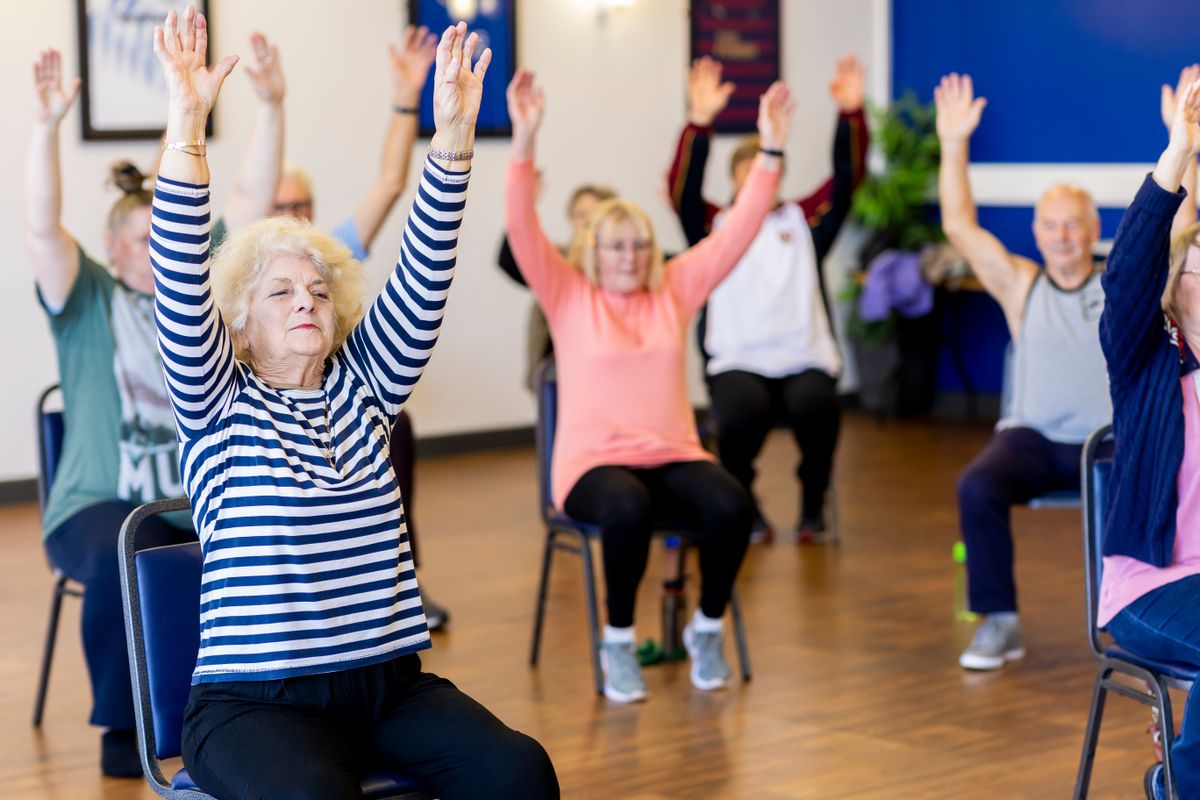
The routine itself is almost comically short. Four moves, each done for 30 seconds with 30 seconds of rest between, once a day, seven days a week: push-ups, chair stands, two-arm seated rows with a resistance band, and stepping up and down on a small adjustable step. Participants were given four resistance bands (10–40 pounds) and a stepper adjustable to 4, 6, or 8 inches, plus modifications for every move — push-ups from a wall or kitchen counter, chair stands with hands on the knees, a 4-inch step to start. As people improved, they were encouraged to progress: lower push-up surfaces, arms crossed for chair stands, a heavier band, a higher step. The program also came with support that a bare "four minutes" headline leaves out: video coaching at baseline and at weeks 2, 4, and 8, daily email reminders, and performance feedback every two weeks. Outcomes were measured by video at baseline and at weeks 6 and 12, using three standard clinical tests: the 30-second chair stand, the five-times sit-to-stand, and the one-legged stance.
The findings, plainly
- Chair stands jumped by 4.2 more than the control group. In 30 seconds, the exercise group went from an average of 9.5 stands at the start to about 14.6 — a gain of 5.1 stands, versus 0.9 in the control group, a difference of 4.2 repetitions (95% confidence interval 2.8–5.7, p < 0.001). Starting from under 10 stands in 30 seconds is itself a sign of fall risk, so the gain moved people from a risky range into a safer one.
- Balance improved too. The exercise group held a one-legged stance 3.6 seconds longer than the control group (95% CI 0.6–6.5, p = 0.02), and they completed five sit-to-stands 2.3 seconds faster (95% CI 0.5–4.1, p = 0.01). All three tests improved — strength, balance, and speed of getting up.
- Only 60 seconds of it was leg work. Chair stands and step-ups — the two lower-body moves — added up to one minute a day. The authors' conclusion is blunt: a 12-week program with only 60 seconds of lower-body exercise per session still improved functional performance in older adults with walking difficulty.
- People actually stuck with it. Participants completed the workout on 81% of days — about 5.7 days a week — and no significant adverse events were reported. Short, it turns out, is easy to repeat, and the daily email reminders and coaching check-ins probably helped.
- The tests matter because they predict real life. As lead author Christopher Sciamanna put it, these measures "predict your future ability to go into a nursing home, your future likelihood of falling and of developing difficulty walking." The trial measured the predictors, not the outcomes themselves — but the predictors are the ones clinicians use to flag risk.
What it doesn't prove
Five honest caveats. First, and biggest: this was 12 weeks of function tests only. The study measured chair stands, balance, and sit-to-stand speed — it did not measure falls, fractures, bone density, heart health, or body composition, and the authors say plainly it doesn't show four minutes is enough for those. Second, it was small — 97 people, all from one area around Hershey, Pennsylvania — and everyone needed internet access and a clean heart-risk screen, so the results may not travel to people with heart symptoms or without that support. Third, nobody was blinded: participants and the staff running the tests knew who was exercising, though a blinded second rater reviewed the videos for quality and safety. Fourth, the "four minutes" came with coaching — four video check-ins, daily reminders, and biweekly feedback — so doing it entirely alone may stick less well. And fifth, a disclosed competing interest: lead author Dr. Sciamanna is part-owner of two companies, BandUp, Inc. and Play Fitness, LLC, formed to test business models for spreading findings from exercise studies. The trial ran from May 2021 to January 2022, with outcomes measured by video, which is another reason to read the results as promising rather than definitive.
What it means after 40
If you are 65 or older, mostly inactive, and walking is already getting harder, this is a real, evidence-backed place to start — and the starting bar is lower than most people assume. Test yourself first: sit in a sturdy chair, arms crossed, and count full stands in 30 seconds. In this trial the exercisers started at about 9.5. Then do the four moves daily — 30 seconds on, 30 seconds off, using the easier version of each that lets you move with good form — and retest at 6 and 12 weeks. A gain of two or more chair stands is a meaningful change. If you are in your 40s or 50s and already active, think of this as a daily floor, not the whole house: it was tested on people 65 and older with walking difficulty, and a fit 50-year-old would likely need more challenge to see similar gains. Four minutes is a door, not the destination — U.S. guidelines still call for muscle-strengthening work at least two days a week plus about 150 minutes of moderate activity, with balance work for older adults. And a safety note the trial itself built in: it screened out anyone with chest pain on a standard questionnaire. If you have heart symptoms, recent surgery, frequent falls, or use a walker, check with your clinician first. Put the chair against a wall, the step in a corner, and stop if pain changes how you move.
Sources
Dandekar S, Kurth J, Shang Y, et al., "Brief daily functional strength training to improve functional performance in older adults with mobility disability: A randomized trial," PLOS One, 2026;21(3):e0336748 (published March 12, 2026; doi:10.1371/journal.pone.0336748) — randomized trial, 97 adults 65+ (mean age 74, 68% women), all with difficulty walking a quarter mile; 44 FAST-2 / 53 delayed-treatment control; 4-minute daily routine (push-ups, chair stands, two-arm rows, stair stepping, 30 seconds each + 30 seconds rest), 12 weeks; versus control, +4.2 chair stands in 30 seconds (95% CI 2.8–5.7, p < 0.001), +3.6 seconds one-leg stance (95% CI 0.6–6.5, p = 0.02), −2.3 seconds five-times sit-to-stand (95% CI 0.5–4.1, p = 0.01); workout completed on 81% of days; no significant adverse events; trial registered NCT05697497. PLOS One paper.
Penn State, "Four-minute daily workout improves strength, balance in older adults," June 9, 2026 — participants averaged about 18 minutes of total exercise per week before the study; fewer than one in five older adults do the recommended two days per week of muscle-strengthening activity; lead author Christopher Sciamanna, Penn State College of Medicine. Penn State release.
ScienceDaily, "Just 4 minutes a day can dramatically improve strength after 65," October 21, 2026 — summary of the FAST-2 trial and its 12-week results. ScienceDaily report.
Studies cited · Evidence summarized, not medical advice
Keep Going
▶️ Watch the videos: Health After 40 Science on YouTube
🌐 Guides, reviews & free checklists: healthafter40science.com
📚 The Health After 40 Bundle — all five guides in one: get the bundle
Get the Free Weekly Email: