Muscle Power — Not Just Strength — Tracked Longevity in a 2026 Study of 2,134 Older Adults
Strength is how much force you can produce. Power is how fast you can produce it — and everyday life runs on speed. Catching yourself on a stumble, getting out of a low chair, hurrying up a flight of stairs: none of those wait for a slow, grinding effort. A 2026 study of 2,134 adults aged 65 and older found that low sit-to-stand power — how quickly someone can rise from a chair, measured as power — was tied to poorer physical function and higher all-cause mortality in both men and women, and in men it tracked slow walking speed even better than grip strength did. The message is not that strength no longer matters. It is that strength alone is an incomplete picture, and power fades faster than strength as we age.
Strength vs. power, in one paragraph
Think of it this way: strength is the size of the engine, power is how fast it delivers. A person can be strong enough to lift a heavy box slowly yet still struggle to recover from a trip, because recovery demands force now. Researchers measure sit-to-stand power with a simple test: stand up from a chair as fast as you can, usually five times or for 30 seconds, and the speed, body weight, and chair height are converted into watts of power. It needs no gym equipment and no grip device, which is part of why clinicians like it — and part of why this study's authors compared it head-to-head with handgrip strength, the field's long-standing standard.
How the study worked
The research, published in 2026 in Experimental Gerontology (volume 221) by García-Aguirre and colleagues, drew on 2,134 adults aged 65 and older (average age 74.2, 54.4% women) from the Toledo Study of Healthy Ageing in Spain. Each participant was assessed for handgrip strength and sit-to-stand power, with both measures also adjusted for body size (normalized by height squared, the "allometric" values). The researchers then examined how low power and low grip strength related to low functional ability — slow usual walking speed, cognitive impairment, and disability — and to all-cause mortality, using sex-specific cut-off points and models that accounted for other factors.
The comparison matters because grip strength has dominated this field for years. Grip is easy to measure and has a long track record of predicting health outcomes. But grip is a static squeeze of the hand; it says little about the legs, balance, and coordination that keep someone upright and independent. Sit-to-stand power, by contrast, runs through the hips, knees, and trunk — the same chain that gets you off the toilet, out of a car, and back on your feet after a misstep.
The findings, plainly
- Low power tracked worse function and higher mortality in both sexes. In men, low absolute sit-to-stand power was associated with roughly double the odds of lower functional ability and death (pooled odds ratios 2.29 and 2.21 for absolute and body-size-adjusted power), similar in size to what low grip strength showed. The pattern held for women as well.
- In men, power beat grip on walking speed. Low sit-to-stand power had a stronger association with slow usual walking speed than low handgrip strength did — a notable result, since walking speed is itself one of the most trusted markers of aging health.
- A second, larger study points the same way. Research published in Mayo Clinic Proceedings in 2025 followed 3,889 men and women aged 46 to 75 for a median of 10.8 years and found muscle power relative to body weight was a much stronger predictor of mortality than relative grip strength: men in the lowest-power group had 5.88 times the mortality hazard of the highest-power group, and women 6.90 times.
- Low power also showed up in falls, fractures, and hospital stays. A companion analysis in the Journal of Sport and Health Science (December 2026, 1,876 adults aged 65 and older) linked low relative sit-to-stand power to a history of falls and fractures in men and hip fractures in women, predicted hospitalization in women, and was associated with longer hospital stays and higher all-cause mortality in both sexes.
- The test itself is the practical news. The 30-second sit-to-stand power test is low-cost, needs only a chair and a stopwatch, and can flag at-risk older adults in a clinic visit — which is why the authors frame it as a feasible screening tool, not just a research curiosity.
What it doesn't prove
Three honest caveats. First, these are observational associations: people with low power died sooner and functioned worse, but the studies do not prove that training power itself extends life — no randomized trial here assigned people to power training and counted deaths. Second, the headline 2026 study enrolled adults 65 and older, so applying it to people in their 40s and 50s is an extrapolation: the reasonable reading is that power is worth building before it becomes a problem, not that a 45-year-old's chair-stand time predicts their lifespan. Third, a low test score is a screening flag, not a diagnosis — it can reflect pain, arthritis, a bad knee, or a bad day, and it says nothing certain about any one individual's future.
What it means after 40
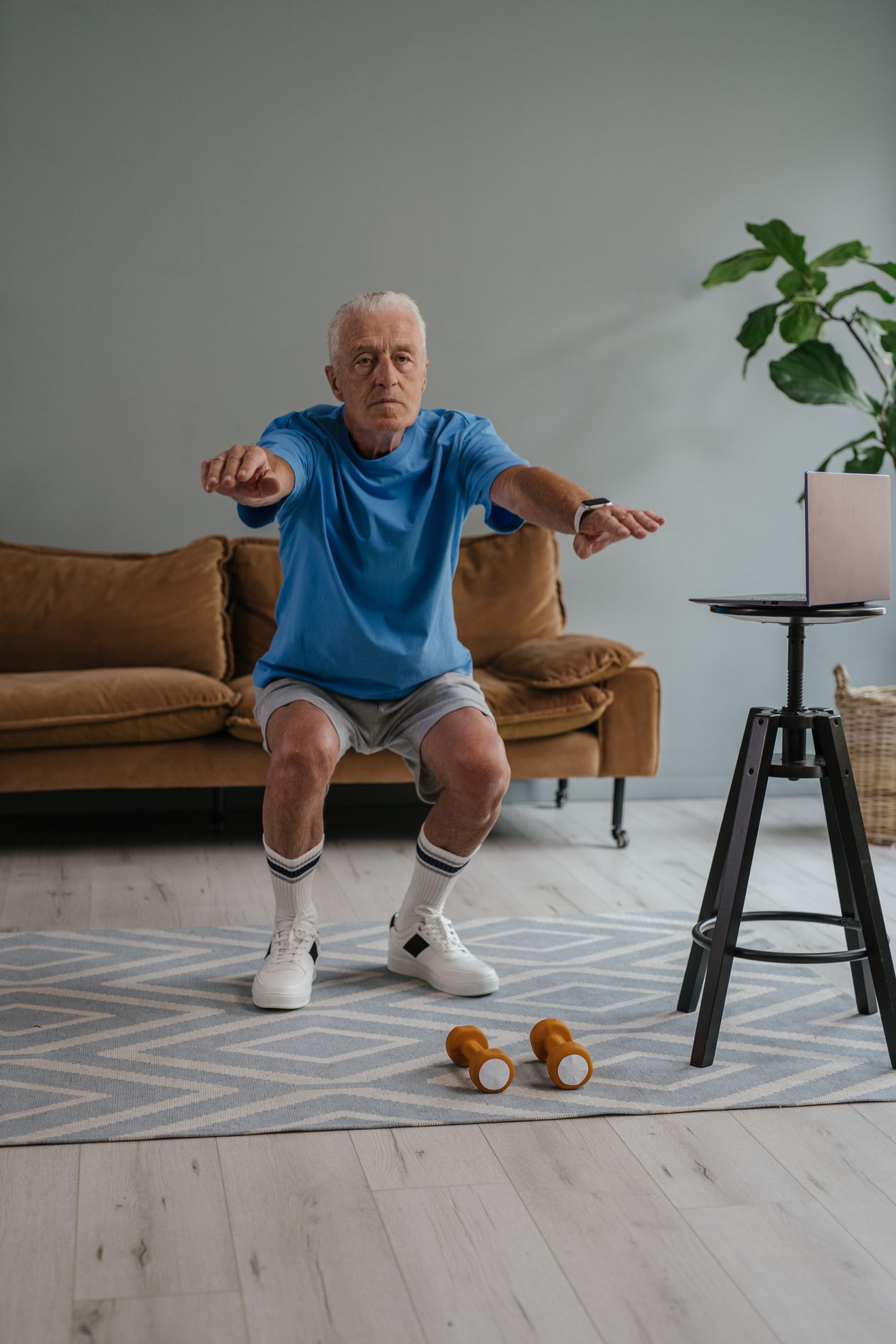
The practical takeaway is a small shift in how you train, not a new program. If you already lift, keep lifting — strength is the foundation power is built on. Then add a speed element a couple of times a week: sit-to-stand repetitions from a sturdy chair (feet flat, arms crossed or lightly supported, stand briskly and sit with control), step-ups, or lifting a lighter weight with deliberate speed on the way up and control on the way down. Brisk stair climbing counts too. The dose does not need to be extreme; the studies' point is that the speed component is what ordinary slow lifting leaves out.
Start conservatively and stay safe. Use a sturdy chair against a wall, keep a handhold nearby if balance is shaky, and stop if anything hurts sharply or you feel dizzy. If you have knee or hip arthritis, a heart condition, or a history of falls, check with your clinician or a physical therapist before adding fast movements — power training done badly (jerky, off-balance, overloaded) is worse than slow training done well. And treat the chair-stand test as a useful self-check, not a verdict: if rising from a chair has clearly gotten harder or slower over a year, that is worth mentioning at your next appointment, because it is exactly the kind of early signal these studies say clinicians should not ignore.
Sources
García-Aguirre, M., et al., "Sit-to-stand power vs. handgrip strength for the assessment of muscle function in older people," Experimental Gerontology, volume 221, August 2026 (2,134 adults aged ≥65, mean age 74.2, 54.4% female; Toledo Study of Healthy Ageing). Companion analysis: García-Aguirre, M., et al., "Low relative sit-to-stand power is associated with history of falls, fractures, hospitalizations, and all-cause mortality," Journal of Sport and Health Science, volume 15, December 2026 (1,876 adults aged 65+). Context: 2025 Mayo Clinic Proceedings cohort, 3,889 adults aged 46–75, median 10.8 years (lowest- vs highest-power mortality hazard 5.88 in men, 6.90 in women). Coverage: Australasian Leisure Management, "Exercise New Zealand spotlights research on muscle power's association with longevity".
Study cited · Evidence summarized, not medical advice
Keep Going
▶️ Watch the videos: Health After 40 Science on YouTube
🌐 Guides, reviews & free checklists: healthafter40science.com
📚 The Health After 40 Bundle — all five guides in one: get the bundle
Get the Free Weekly Email: