Lifting Weights May Slow Brain Aging by 1–2 Years — What a 309-Person Trial Found
A year of strength training made the brains of older adults look younger on a scan — by about a year and a half, on a computer's estimate. A randomized trial published February 10, 2026, in GeroScience assigned 309 healthy adults aged 62–70 to heavy resistance training, moderate-intensity training, or no exercise, then measured their "brain age" from resting brain scans. Both training groups came out with a lower brain-age gap after the year of training — about 1.4 years lower — and the difference was still there a year after the program ended, at roughly 1.8 to 2.3 years. The no-exercise group did not change significantly. It is a real, randomized finding, but the headline needs proportion: the brain-age clock is a rough model with an average error of about 8.7 years per person, the study measured no memory or thinking, and the extra change over doing nothing was smaller than the headline numbers suggest — roughly 0.8 years after a year of training.
Why the question matters
Strength training is already one of the best-supported habits after 60: it builds muscle, protects bone, improves balance, and lowers fall risk. What has been less clear is whether it changes the brain itself in a measurable way. Most earlier studies looked at single brain regions — the hippocampus, say — and found mixed results. A newer approach is the "brain age clock": a machine-learning model trained on thousands of brain scans learns what a typical brain looks like at each age, then estimates the age of a new brain from its scan. The gap between that estimate and the person's real age is the brain-age gap. A negative gap means the brain looks younger than expected, and in large observational studies a smaller gap tracks with better brain integrity and cognitive performance. The question this trial asked was whether a year of lifting could actually move that clock — and whether the effect would last once training stopped.
How the study worked
The researchers used the LISA trial — Live Active Successful Aging — run in Copenhagen, Denmark, at the Institute of Sports Medicine Copenhagen and the Danish Research Center for Magnetic Resonance. The analysis included 309 healthy adults aged 62–70, approaching retirement age, randomly assigned to one of three groups for a year. The heavy resistance training group attended three supervised sessions a week at a training center. The moderate-intensity group attended one supervised session a week and did two more sessions at home, unsupervised. Both programs combined resistance exercises with functional training aimed at improving strength, endurance, and balance, with intensity set individually and progressed gradually. The control group was told to keep their usual activity — less than one hour of strenuous activity a week. People with significant medical or musculoskeletal conditions, medications likely to interfere, or neurological problems were excluded. Everyone had resting-state functional MRI scans and fitness tests at the start, after one year, and again at two years — a full year after the supervised program had ended. The brain-age clock itself was trained on an independent dataset of 2,433 healthy adults, using 6,670 measures of how different brain regions communicate with each other at rest. The model's average error when estimating one person's brain age was 8.652 years.
The findings, plainly
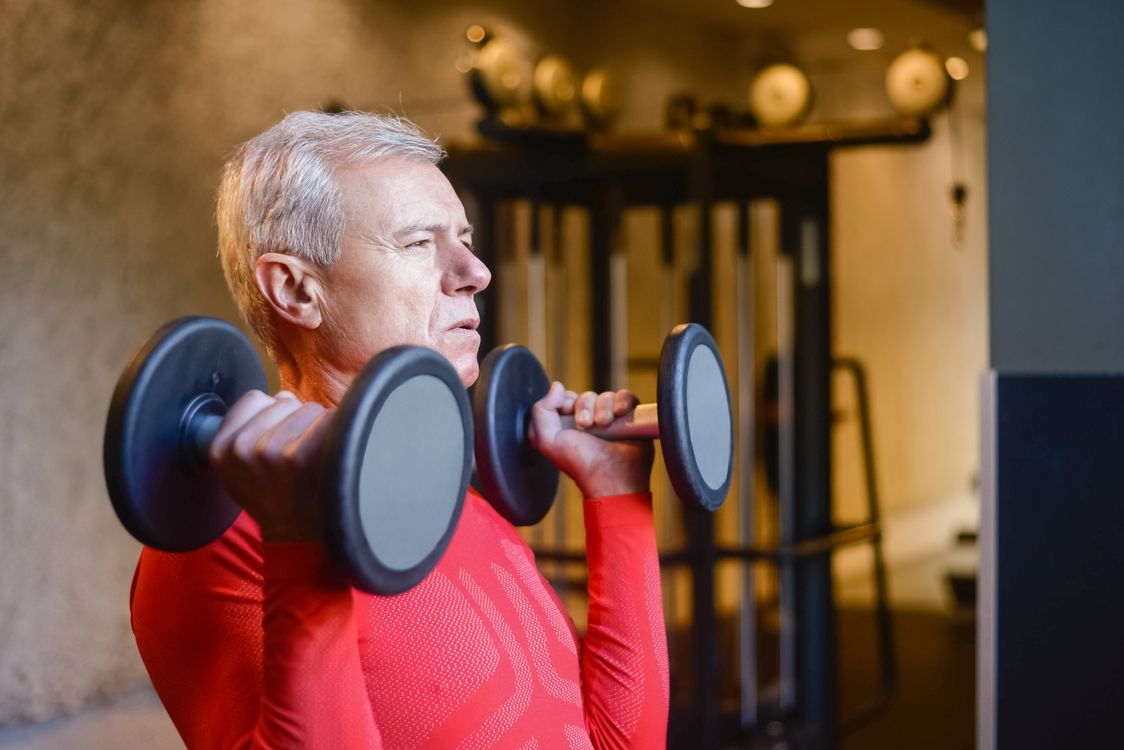
- Heavy training: brain age fell 1.4 years after a year, 1.84 years at two years. In the heavy resistance training group, the brain-age gap dropped by 1.4 years from baseline after the year of training, and by 1.84 years at the two-year scan — a year after training had stopped (both statistically significant after correction for multiple comparisons).
- Moderate training: 1.39 years at one year, 2.26 years at two years. The moderate-intensity group — one supervised session plus two home sessions a week — showed essentially the same benefit as the heavy group. More lifting did not buy a bigger brain-age effect.
- The no-exercise group did not change significantly. The control group drifted down slightly (by about 0.7 and 0.8 years at the two scans, per the paper's table), but those changes were not statistically significant. The overall test of whether the groups changed differently over time was significant (p = 0.031).
- The honest comparison is smaller than the headline. The paper's headline numbers are each training group compared with itself, not with the control group. Subtracting the control group's drift gives the extra change over doing nothing: about 0.8 years after a year of training (1.42 − 0.66 for heavy, 1.39 − 0.66 for moderate) and about 1 to 1.4 years at two years. That arithmetic is ours, not a test the paper ran.
- Heavy training also strengthened prefrontal connectivity. Only the heavy group showed a significant increase in functional connectivity in the prefrontal cortex — the region behind attention, executive control, and working memory — compared with the control group (a cluster of 8,517 voxels, pFDR < 0.001). The moderate group did not show this local effect.
- The effect was whole-brain, not local. When the clock was restricted to single brain networks — default mode, motor, cerebellar, visual, and others — no significant group differences appeared. The change showed up only when the clock looked at the whole brain, suggesting a distributed, global effect rather than one region doing the work.
- Strength gains barely tracked the brain change. Across everyone, people whose leg strength improved most also saw their brain-age gap fall most — but the link was tiny (r = −0.12, p = 0.036), reached significance only in the moderate group (r = −0.21), and ran the other way in the heavy group (r = 0.09, not significant). Getting stronger was not the main driver of the brain-age change.
- The benefit outlasted the training. Both training groups kept their leg-strength gains a year after the program ended, and the brain-age gap stayed lower at the two-year scan — the effect did not wash out when the supervised sessions stopped.
What it doesn't prove
Five honest caveats. First, the brain-age clock is a rough instrument: its average error is about 8.7 years when estimating one person's brain age, so a 1–2 year shift is small next to the model's own noise — the result is meaningful at the group level, not as a number you could put on any individual. Second, the study measured no memory or thinking, so it cannot say whether anyone's brain actually worked better — only that a scan-based estimate moved. Third, the participants were healthy older adults from a high-income European country, and people with significant medical conditions were excluded, so the results may not apply to people with health problems or in other populations. Fourth, the authors themselves describe the 1–2 year reduction as modest and say its clinical meaning needs testing with longer follow-up — a smaller brain-age gap is a promising marker, not a proven reduction in dementia risk. Fifth, the headline figures are within-group changes, not the difference versus the control group, so the true edge over doing nothing is roughly half the headline at one year.
What it means after 40
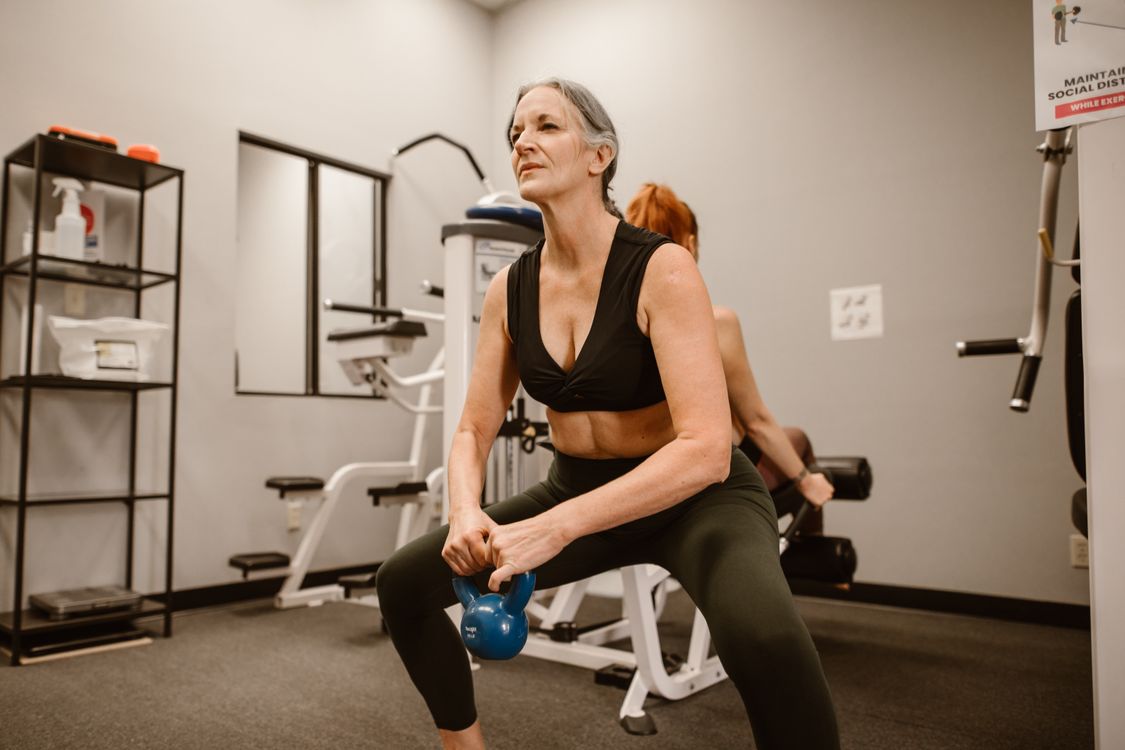
For adults in their 40s, 50s, and 60s, the practical message is encouraging but proportionate. Strength training already earns its place for muscle, bone, balance, and fall prevention — this trial adds a brain signal on top, and the striking part is that moderate training matched heavy training. You do not need to lift the heaviest weights in the room: one supervised session a week plus two home sessions produced the same brain-age change as three supervised gym sessions. What the study does not do is promise that lifting will keep your memory sharp or prevent dementia — that was not measured, and the clock itself is too rough to hang a personal claim on. If you are starting strength training in your 60s, the trial's design is a useful template: a structured program, intensity set to your level and progressed gradually, supervised at first if you are new to it, and medical clearance if you have a condition the trial would have excluded. The benefit, if it holds up in longer studies, is one more reason the habit is worth building — not a reason to buy a brain-age scan.
Sources
Gonzalez-Gomez, R., Demnitz, N., Coronel, C., Gates, A. T., Kjaer, M., Siebner, H. R., Boraxbekk, C. J., & Ibanez, A. M. (2026). "Randomized controlled trial of resistance exercise and brain aging clocks," GeroScience, 48, 3251–3262, published online February 10, 2026. DOI: 10.1007/s11357-026-02141-x (309 healthy adults aged 62–70 from the LISA randomized trial in Copenhagen; heavy resistance training 3 supervised sessions/week, moderate-intensity training 1 supervised + 2 home-based sessions/week, non-exercise control; 1-year intervention, scans at baseline, 1 year, and 2 years; brain clocks trained on resting-state fMRI from 2,433 independent healthy adults, 6,670 connectivity features, LightGBM models, mean absolute error 8.652 ± 0.304 years; heavy group brain-age gap fell 1.4 years at 1 year and 1.84 years at 2 years, moderate group 1.39 and 2.26 years, pFDR < 0.05; no significant change in the control group; group-by-time interaction significant; heavy training increased prefrontal functional connectivity vs control, cluster 8,517 voxels, pFDR < 0.001; effects at whole-brain level only, no significant effects in single resting-state networks; leg-strength change vs brain-age-gap change r = −0.12, p = 0.036 overall, r = −0.21 in the moderate group, r = 0.09 and not significant in the heavy group; both training groups increased leg strength and maintained gains a year later; authors call the 1–2 year reduction modest and say clinical significance needs longer follow-up). Paper (DOI).
Plain-language analysis of the paper's table and numbers: The Protocol Club, "Does Lifting Weights Slow Brain Ageing? A Trial in 309 Adults Aged 62–70" (October 19, 2026) (control group drifted down 0.66 and 0.82 years, not significant; group-by-time p = 0.031; extra change over doing nothing ≈ 0.8 years at 1 year and ≈ 1–1.4 years at 2 years by subtraction from the paper's table; model average error 8.652 years; paper did not measure memory or thinking; small text/table inconsistencies, e.g. 1.84 vs 1.85 years — table values used here).
Parent trial registration: LISA (Live Active Successful Aging), ClinicalTrials.gov NCT02123641 (one-year supervised strength-training randomized trial in Danish adults at retirement age).
Studies cited · Evidence summarized, not medical advice
Keep Going
▶️ Watch the videos: Health After 40 Science on YouTube
🌐 Guides, reviews & free checklists: healthafter40science.com
📚 The Health After 40 Bundle — all five guides in one: get the bundle
Get the Free Weekly Email: