Beetroot Juice + Lifting: The Supplement That Added Nothing
Beetroot juice is one of the best-studied sports supplements there is — for endurance. Its nitrates turn into nitric oxide, which widens blood vessels and helps muscles use oxygen, and the Australian Institute of Sport lists it among its Group A supplements, reserved for products with strong evidence in specific situations. But almost all of that evidence is about running and cycling, not lifting. A 2026 trial from Auburn University asked the tougher question: if middle-aged and older adults drink beetroot juice every day while following a supervised lifting program, does the juice make the lifting work better? The answer was a clean no. The lifting worked. The juice added nothing — not on strength, not on muscle growth, and not on the molecular markers inside the muscle itself.
Why beetroot juice was supposed to help
The logic was reasonable. Nitric oxide does more than widen blood vessels: it is also involved in how muscles contract, how mitochondria — the cell's energy factories — function, and how the muscle handles oxidative stress. Since resistance training is known to stimulate mitochondrial biogenesis, especially in older people whose mitochondrial function has typically declined, researchers hypothesized that extra dietary nitrate might amplify that effect. There was also one encouraging hint: an earlier open-label study in postmenopausal women who did eight weeks of circuit training reported large effects of beetroot juice on maximal knee extensor power and aerobic capacity. But that study was open-label — everyone knew who was getting the juice — so it could not separate a real effect from expectation. What the field lacked was a blinded, placebo-controlled test in middle-aged and older lifters, with actual muscle tissue to look at. That is what Auburn set out to run.
How the study worked
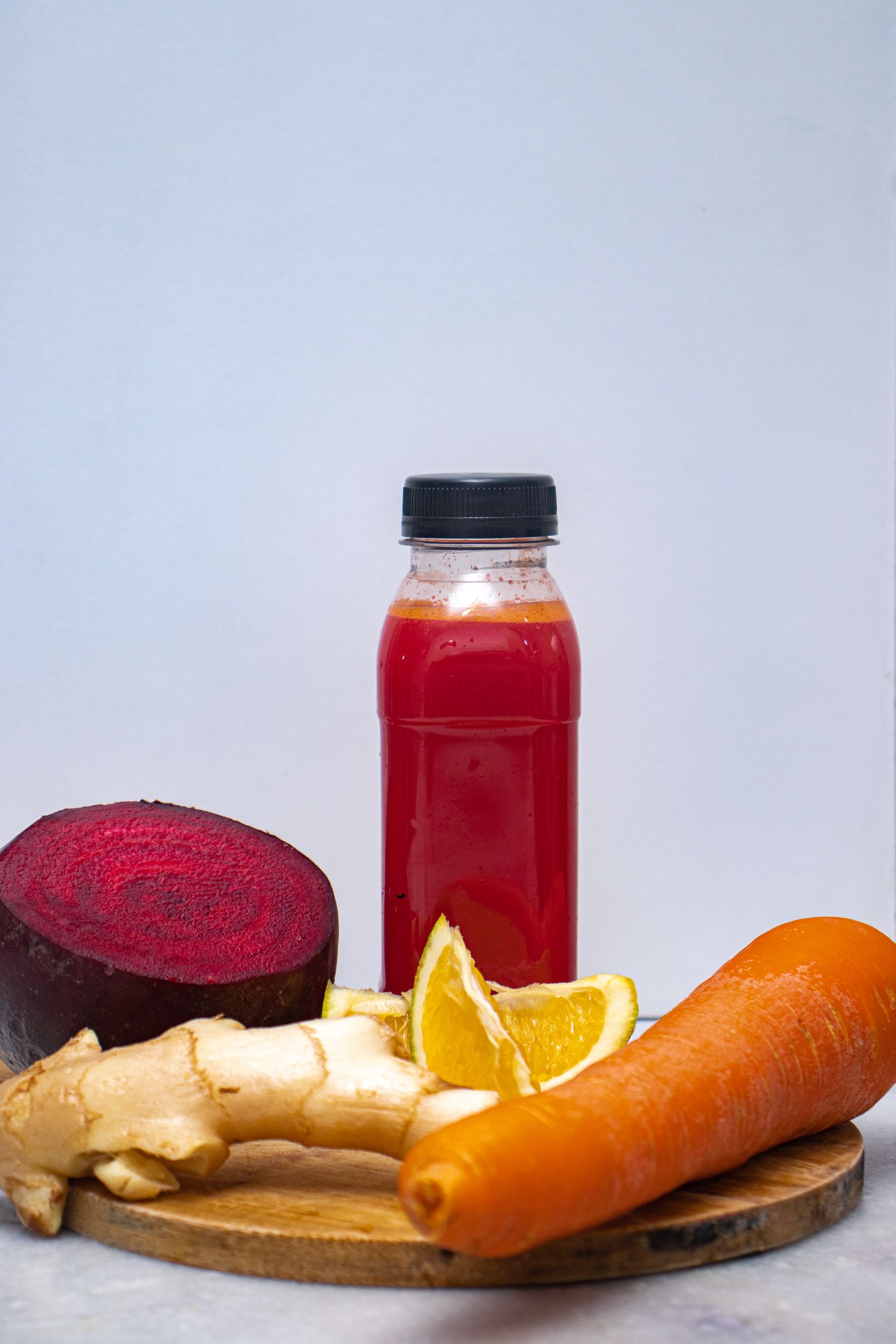
Twenty-eight untrained adults were enrolled — people with no or minimal aerobic or resistance exercise more than once a week in the previous year — and 27 completed the analysis (13 men, 14 women), averaging 56 years old. They were block-randomized by sex and baseline lean body mass into two groups, and neither the participants nor the researchers collecting the data knew who was in which group. One group drank 140 ml a day of nitrate-rich beetroot juice (about 13 mmol of nitrate, the commercial Beet It shot); the other drank the same amount of nitrate-depleted beetroot juice as a placebo (about 0.08 mmol). On training days the drink was taken two hours before the session. Everyone completed 12 weeks of supervised total-body resistance training, twice a week — hex bar deadlifts, 45° leg press, seated leg extensions, lying hamstring curls, machine chest press, and cable pulldowns — with loads increased steadily over the program. Before and after, the researchers took small muscle biopsies from the thigh (vastus lateralis) and tested leg extensor peak force, strength-endurance, and fatigue on a dynamometer. This was a follow-up analysis of the same trial reported earlier in 2026 by McIntosh and colleagues, which had already looked at strength, muscle size, and blood-vessel outcomes; this paper added the mitochondrial and redox markers from the biopsies.
The findings, plainly
- The lifting worked — for everyone. Across both groups, 12 weeks of training increased citrate synthase activity in the thigh muscle (a marker of mitochondrial content), raised proteins involved in mitochondrial biogenesis and remodeling, and improved most measures of leg extensor performance. The training stimulus did exactly what it is supposed to do.
- The juice added nothing. The authors' conclusion was unusually blunt: "BRJ supplementation did not confer additional benefits with any of the outcomes." Not on mitochondrial markers, not on redox balance, not on leg strength, endurance, or fatiguability.
- The same story showed up in the companion analysis. The earlier McIntosh et al. report on the same 28 participants found no added benefit from beetroot juice on whole-body lean mass, thigh muscle cross-sectional area, or artery dilation (flow-mediated dilation). Muscle nitrate markers rose a little in the juice group (+15.4% versus +7.8% on placebo) but not enough to be statistically meaningful.
- Endurance and strength are different questions. A 2026 review in Nutrients found beetroot juice most consistently benefits endurance performance — reducing oxygen cost and improving exercise economy — while its effects on strength and neuromuscular power were much less uniform. A separate randomized dose-response study in resistance-trained men likewise found dietary nitrate did not change resistance exercise performance at any dose tested.
- Small study, one dose, one timing. Twenty-seven people is a small trial, the dose was fixed at about 13 mmol a day rather than adjusted for body weight, and everyone was untrained. The authors themselves note that nitrate timing and dosage need further investigation before the question is fully closed.
What it doesn't prove
Three honest caveats. First, a null result in 27 people is not proof that nitrates can never help anyone lift — it is evidence that this dose, taken daily alongside this training program, added nothing measurable for these untrained adults. A higher dose, different timing, or a trained population could in principle behave differently, though the dose-response study in trained men points the same way. Second, this says nothing against beetroot juice for endurance: the acute evidence for running and cycling performance still stands, and that is where the Group A listing comes from. Third, it does not mean beets are useless as a food — beets are a nutritious vegetable, and this trial tested a concentrated supplement dose for a specific training-adaptation purpose, not eating beets. One transparency note: the trial was approved by Auburn's institutional review board but was not pre-registered, which the authors disclose in the paper.

What it means after 40
If you already lift, this is good news disguised as a disappointment: the training itself is doing the work. In twelve weeks, two supervised sessions a week improved the energy machinery inside the muscle and made legs measurably stronger and more enduring — no supplement required. If you were buying beetroot juice shots hoping they would make your lifting sessions count for more, the current evidence says save the money. The supplement's real, evidence-backed job is endurance performance, not strength adaptation. And if you are not lifting yet, this trial is a reminder of where the return actually lives: a structured, progressive program, done consistently, twice a week. That is the intervention that moved every marker the researchers measured — the juice just rode along.
Sources
"The effects of chronic beetroot juice supplementation with resistance training on skeletal muscle mitochondrial and redox markers in middle-aged and older adults," European Journal of Applied Physiology, 2026, DOI: 10.1007/s00421-026-06460-x (Auburn University; 27 untrained adults, 56 ± 7 years, 13 men and 14 women; double-blinded, block-randomized; 140 ml/day nitrate-rich beetroot juice, ~13 mmol nitrate, vs nitrate-depleted placebo, ~0.08 mmol; 12 weeks supervised total-body resistance training twice weekly; vastus lateralis biopsies and isokinetic leg extensor testing before and ~72 hours after the final session; training increased citrate synthase activity, mitochondrial biogenesis/dynamics proteins, and most leg extensor performance variables in all participants; "BRJ supplementation did not confer additional benefits with any of the outcomes"; dose not normalized to body weight; trial not pre-registered — IRB protocol 24-863). Full text: link.springer.com/article/10.1007/s00421-026-06460-x.
Companion analysis of the same trial: McIntosh et al., "Effects of 12-Week Dietary Nitrate Supplementation with Resistance Training on Skeletal Muscle and Vascular Outcomes in Older Adults," 2026 (28 adults, 56 ± 7 years; 140 ml/day beetroot juice providing 800 mg nitrate vs nitrate-depleted placebo; 12 weeks supervised full-body resistance training twice weekly; both groups improved hypertrophy, strength, and flow-mediated dilation; no significant group × time interactions for whole-body lean mass, mid-thigh muscle cross-sectional area, popliteal artery flow-mediated dilation, or molecular markers; muscle NOx +15.4% in the beetroot juice group vs +7.8% on placebo, not significant). Preprint: preprints.org/manuscript/202507.2250.
Context and independent coverage: Men's Journal, "Researchers Added Beet Juice to Strength Training and One Result Stood Out" (October 6, 2026) (trial summary; Australian Institute of Sport Group A classification for dietary nitrate/beetroot juice; 2026 Nutrients review — beetroot juice most consistently benefits endurance performance by reducing oxygen cost and improving exercise economy, with less uniform neuromuscular effects; separate randomized dose-response study in resistance-trained men found dietary nitrate did not impact resistance exercise performance at any dose assessed; researchers note the small sample and that nitrate timing and dosage need further investigation).
Studies cited · Evidence summarized, not medical advice
Keep Going
▶️ Watch the videos: Health After 40 Science on YouTube
🌐 Guides, reviews & free checklists: healthafter40science.com
📚 The Health After 40 Bundle — all five guides in one: get the bundle
Get the Free Weekly Email: