Worse Hearing Was Linked to a Thinner Retina — What a 32,613-Person Study Found
Hearing loss and vision loss are usually treated as separate problems of aging — one for the audiologist, one for the eye doctor. A new 2026 study of more than 32,000 adults suggests they may share a common vulnerability: the worse people heard, the thinner the inner layers of their retina were.
How the study worked
The study, published in Investigative Ophthalmology & Visual Science in 2026, was carried out by researchers at Moorfields Eye Hospital in London using data from 32,613 UK Biobank participants — average age 56.8, and 58.1% women. Hearing was measured with the Digit Triplet Test, an automated speech-in-noise test that produces a speech reception threshold (SRT): the louder speech has to be, relative to background noise, before you can make out the numbers. Participants were grouped as normal, insufficient or poor hearing, and for the main analysis the insufficient and poor groups were combined into one impaired-hearing category.
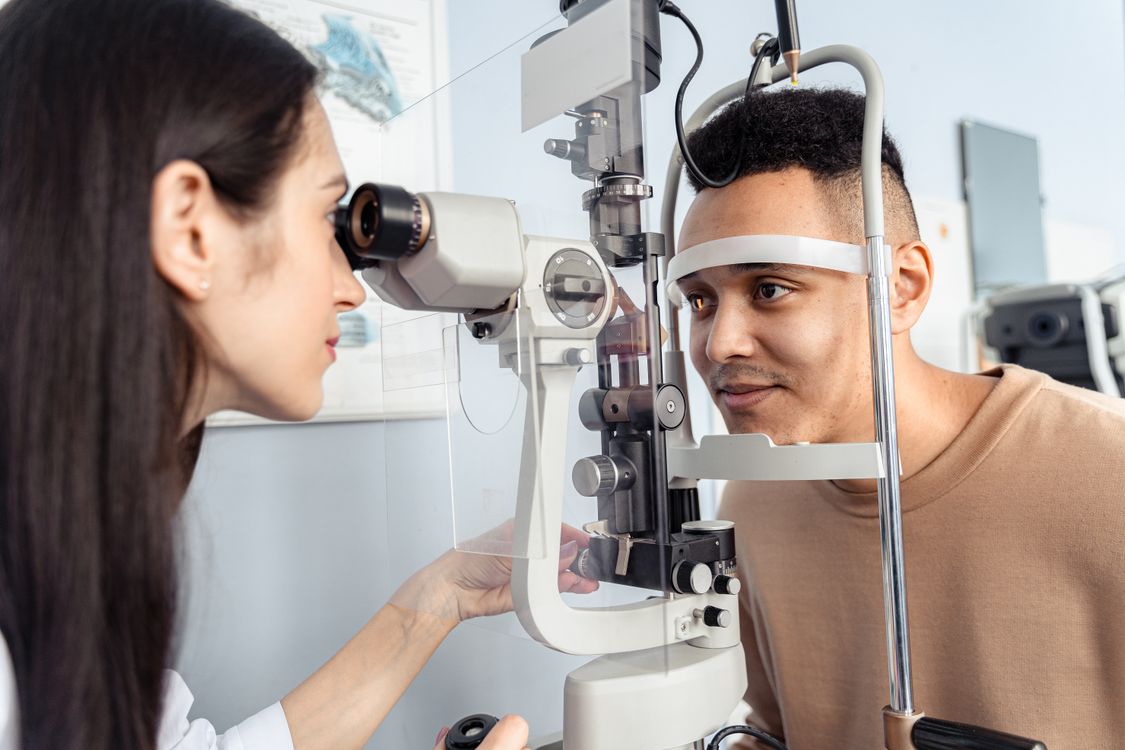
The retina was measured with optical coherence tomography (OCT) — the same painless scan many eye clinics now run at a routine visit. It measured nine distinct retinal layers and layer complexes, from the nerve-fibre layer at the surface down to the pigment epithelium underneath. The analysis adjusted for demographic, lifestyle and health factors.

The findings, plainly
- Every step of worse hearing meant a thinner retina. Each 1-decibel increase in speech reception threshold — meaning worse hearing — was tied to significantly thinner tissue in total macular thickness, the ganglion cell–inner plexiform layer (GCIPL), the inner nuclear layer (INL), and the complex spanning the inner nuclear layer and external limiting membrane (INL-ELM).
- One difference was worth about 11.7 years of retinal aging. Compared with people with normal hearing, the impaired-hearing group had thinner GCIPL, INL, INL-ELM, INL-RPE and total macular thickness. The largest gap, in the INL-ELM complex, was equivalent to roughly 11.7 years of age-related retinal change; the INL-RPE gap was worth about 6.4 years, and total macular thickness about 3 years.
- The link was selective, not a blanket thinning. No significant links appeared for the retinal nerve fibre layer, the photoreceptor-related layers or the retinal pigment epithelium — the association was specific to inner and middle retinal structures, not a general thinning of everything.
- It got stronger with age. The links between poorer hearing and thinner GCIPL and INL layers grew stronger as participants got older. The impaired-hearing group also had slightly worse visual acuity than the normal-hearing group.
What it doesn't prove
Three honest caveats. First, this is cross-sectional — hearing and retina were measured at one point in time, so it cannot say whether hearing loss causes retinal thinning, retinal thinning causes hearing trouble, or both are downstream of something else entirely. The authors say exactly that in the paper: the findings "raise the possibility that hearing performance and the inner retinal structure may capture overlapping aspects of neurosensory vulnerability, although the cross-sectional nature of our data cannot establish shared or causal mechanisms." Second, the hearing test measured speech-in-noise performance, not a formal audiometric diagnosis — it is a good screening measure, not a clinical hearing exam. Third, the study proposes two overlapping explanations rather than settling on one: a shared neurovascular vulnerability, since both retinal and cochlear tissue have high metabolic demands and depend on intact microcirculation, and a shared weakness in specialised neural tissue itself. Neither is proven here.
What it means after 40
This is not a reason to worry that struggling to hear in a noisy restaurant means your eyes are failing — it is a reason to stop treating the two senses as unrelated. Both hearing loss and vision loss are already counted as modifiable risk factors for dementia, and this study adds a measurable thread between them: retinal thinning, visible on a routine OCT scan, could one day serve as a marker of broader neural vulnerability shared across the senses. Practically, the takeaway is the same one yesterday's article reached from a different direction: get your hearing checked when conversations start getting harder, keep eye exams current, and mention both at your annual checkup. The senses decline quietly and gradually, and the cheapest interventions — a hearing test, a pair of glasses, a hearing aid — are still the ones people postpone longest.
Sources
Meliante LA, Stuart KV, Meliante PG, et al., "Association between retinal layer thickness and hearing performance in the UK Biobank: a cross-sectional study," Investigative Ophthalmology & Visual Science, 2026;67(13):10. Summary: Review of Optometry, Nov 11, 2026.
Study cited · Evidence summarized, not medical advice
Keep Going
▶️ Watch the videos: Health After 40 Science on YouTube
🌐 Guides, reviews & free checklists: healthafter40science.com
📚 The Health After 40 Bundle — all five guides in one: get the bundle
Get the Free Weekly Email: