Wall Squats 3 Times a Week Cut the Top Blood-Pressure Number by Nearly 14 Points — New 2026 Trial
No gym. No pills. No running shoes. Just your back against a wall and a few minutes of holding still. A new 2026 trial found that simple wall squats, done three times a week, lowered systolic blood pressure by an average of 13.73 points — and even one session a week held onto part of the gain. Here's what the study actually tested, and what it can't tell you yet.
What the study did
Researchers at Canterbury Christ Church University recruited 100 adults (average age 37.4) with normal to high-normal systolic blood pressure — 120 to 140 — who didn't do structured exercise. Nobody in the trial had hypertension, nobody had ever taken blood pressure medication, nobody smoked, and anyone drinking more than 14 units of alcohol a week was out.
For the first four weeks, four groups all followed the same home program: four wall-squat holds per session, separated by two minutes of seated rest, three times a week. A fifth group did nothing and served as the control. Then came the interesting part: for the next four weeks the exercise groups split into different schedules — one kept going three times a week, one dropped to twice, one dropped to once, and one stopped entirely. The question wasn't whether wall squats work. It was how little you can do and still keep the benefit.
The findings, plainly
- Three times a week: systolic down 13.73 points. The group that kept exercising three times a week for the full eight weeks had the biggest drop in the top blood-pressure number versus their starting point.
- Twice a week: down 6.95. Once a week: down 6.56. Both lower-frequency groups still kept a significant systolic reduction compared with the control group — a meaningful result for people who can't commit to more.
- The diastolic gain was fragile. At lower frequencies the groups held onto their systolic and mean-arterial-pressure improvements, but the diastolic (bottom number) advantage faded after the first four weeks.
- Stop, and the benefit reverses. The group that quit after four weeks ended up with blood pressure no different from the controls — the effect needs maintenance.
- Three-a-week also kept heart and vessel gains. The highest-frequency group held onto improvements in total peripheral resistance and heart rate variability, signs the benefit goes beyond the reading on the cuff.
What it doesn't prove
Two honest caveats. First, nobody in this trial had hypertension — 120 to 140 systolic is normal to high-normal, and every participant had a clean bill of health otherwise. A 13.73-point drop in someone at 132 does not tell you what wall squats do for someone at 160 on two medications, and the average participant was 37, not 57. Second, the whole trial ran eight weeks, with only four weeks of follow-up for the maintenance question. There's no evidence here about what happens at six months or a year.
One safety note that comes from the study's own design: the researchers excluded anyone with injuries or illnesses, and blood pressure spikes during a sustained isometric hold. If your blood pressure is uncontrolled, get your doctor's sign-off before trying this — this is a prevention exercise for healthy people, not a treatment substitute.

What it means after 40
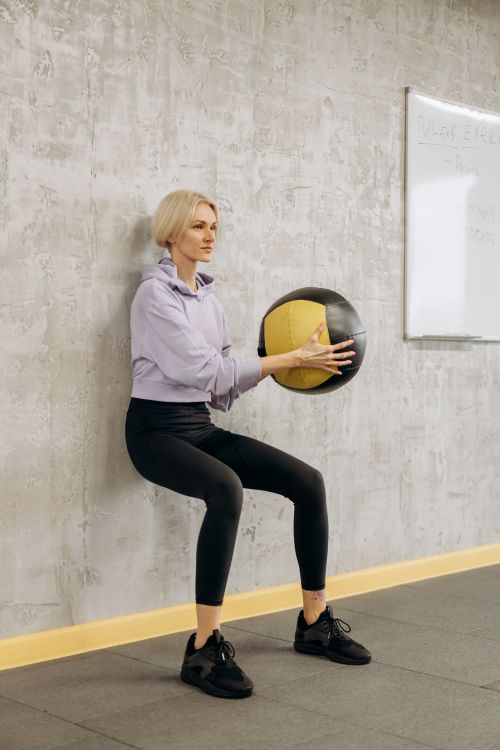
If your numbers are creeping into the 120s or 130s — and your doctor has given exercise a green light — this is one of the lowest-effort interventions in the blood pressure literature. The routine: back flat against a wall, feet out, knees at about 90 degrees so your thighs are parallel to the floor, and hold. Four holds per session with two minutes of seated rest between them, three times a week. Once the habit is built, the trial suggests even a once-a-week session helps you hold onto part of the gain — useful honesty for a busy schedule, but not a license to coast.
This is becoming a pattern, not a fluke. Earlier research has shown isometric exercise lowers blood pressure more than other exercise forms, with effects similar to or greater than some drug treatments. And a February 2026 trial in JACC found that the Chinese mind-body exercise baduanjin lowered blood pressure comparably to some first-line medications, with results sustained over a year. The picture after 40: gentle, consistent, non-aerobic practices are earning their place alongside diet and cardio.
Sources
Primary paper: Swift, H. T., et al. (2026). "Isometric exercise training and blood pressure control: exploring the dose-response to training frequency in a randomised controlled trial." BMJ Open Sport & Exercise Medicine, 12(3): e003172 (peer-reviewed; DOI: 10.1136/bmjsem-2025-003172). Coverage: News-Medical; Healthline; Medical Xpress. Mind-body context: baduanjin blood-pressure trial, JACC, February 2026 (via Health News).
Trial cited · Evidence summarized, not medical advice
Keep Going
▶️ Watch the videos: Health After 40 Science on YouTube
🌐 Guides, reviews & free checklists: healthafter40science.com
📚 The Health After 40 Bundle — all five guides in one: get the bundle
Get the Free Weekly Email: